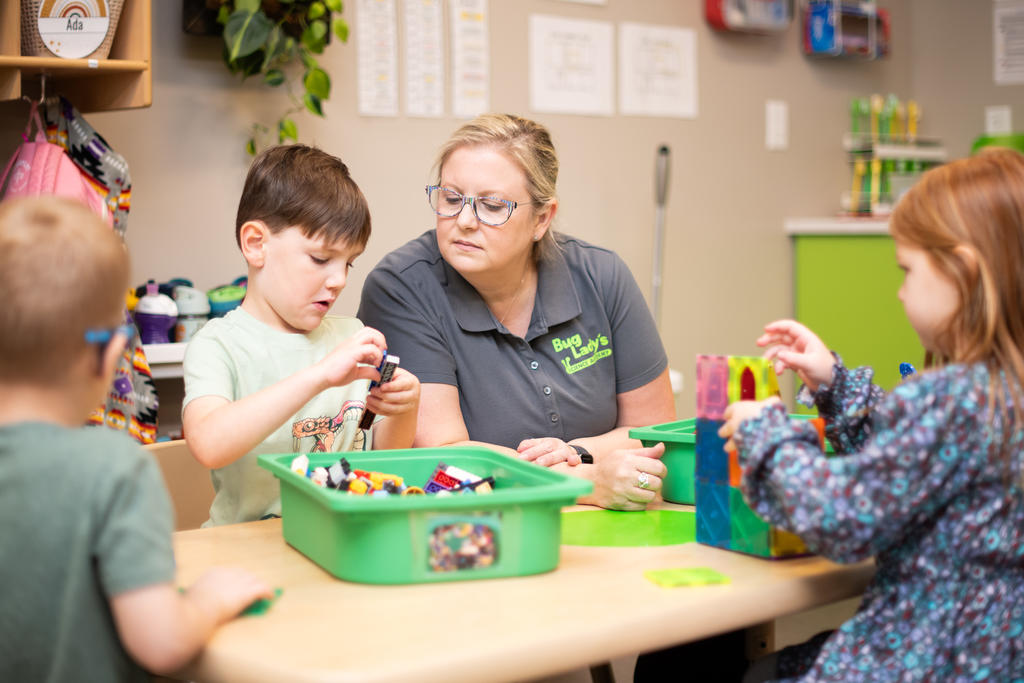
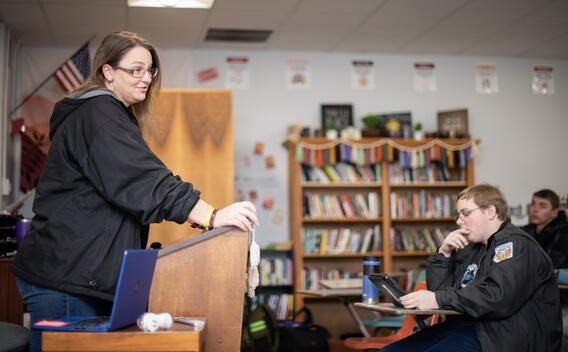
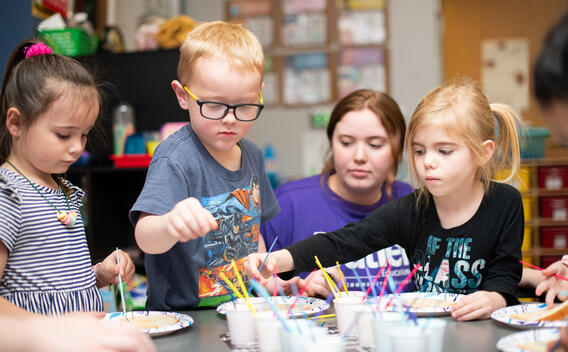
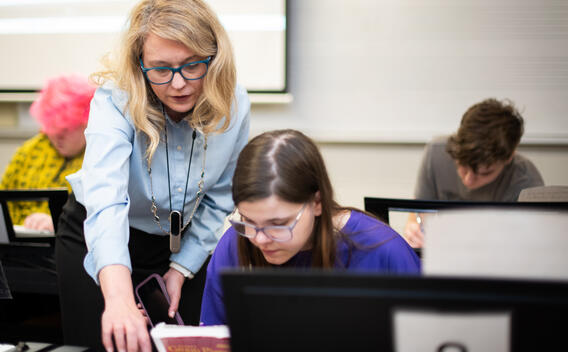
Let's go back to the table and build some stuff. Yay. I'm building my game. Let's go do my game. Let's Let's Let's Let's go down. Early childhood education is a very dynamic field that supports young children and their families at a critical stage of development. And brain research tells us that there's so much learning that's happening in the first five years of life. So what we equip our students to do here at Butler Community College in the early childhood education program is to have a foundational understanding of child development so that they can recognize the unique individual stages of development that children are going through, and yet there are critical windows of opportunity during a child's first five years that teachers need to know how to maximize. So having a foundational understanding of child development is really one of the key factors we consider in our early childhood program. In the early childhood department, they really stood out in the fact that they knew what I was trying to do and they wanted to help me accomplish that. And that was learn more about children, how they learn, how they develop, what are the milestones that they should be reaching. If they're not reaching that milestone, how can we help them get there? That is one of the biggest experience that I have taken away from Butler is how to advocate for children. Another foundational concept that we address in our program is developmentally appropriate practice. What that means is that we are trying to help our students learn how to support every single child in all different stages of development, but do it in a way that is respectful to the child, something that the child is capable of doing and can feel success as they're doing it. Our students leave our program knowing how to implement joyful, engaging activities that support children with all different domains of learning. So it supports their physical health, it supports their emotional and social development, their cognitive development. Every learning domain can be addressed in a developmentally appropriate fashion. And that's what we want our students to know how to do as soon as they walk out of our doors. All of the early childhood classes that I was taking, I could implement into my daily work with the children at my center. As far as behaviors and curriculum and the whole gamut of what you need in order to run a successful program, I learned from Butler. Our students leave our program knowing how to use observation, documentation, and assessment to gather data about young children. And the reason that's so important is they need to know how to think critically about young children and how to support their development so that they can create really engaging, intentional activities that support all learning domains. As students progress through our program, they are creating a portfolio and that portfolio is a great collection of their best activities that they've created in their different classes. So in addition to them learning in the classroom, we are intentional about getting our students out of the college classroom and into the field. And so we have field experiences. Our students engage in practicum classes where they are working about three hundred hours by the time they graduate from our program. So they have a lot of hands on real world experience that supports them as they leave our program and enter the workforce. Working in the classroom and then starting at Butler was, I feel, the ideal situation because I was able to have my profession, go to college, take these courses, get the hands on real life experience, the skills. While learning about it, I was able to implement it in my classroom. It helped being a part of some of the courses such as practicum, where the instructor came out and observed me in the classroom. There are so many different jobs that you can have in the early childhood education field. It's not just being a teaching assistant or a teacher or an administrator. There are home visitors and there are curriculum coaches. So there's a wide variety of jobs that people can hold in the early childhood field. One of the best things about our program is that our instructors really do have that real world industry experience. So they have had twenty plus years in the early childhood field in a number of different roles. And so they bring that into the classroom that really supports our students. My name is Nikia Brunner and I do in home family child care. I've always worked with children. I worked with children in the churches, in the nursery, in Sunday school. I also used to watch children when I was growing up. When I got pregnant I knew I wanted to be home with my kids and I enjoy being with children so why not watch children in my home and I can be at home with my kids. When I went into early childhood education I was able to learn how the children developed, how their brains developed, how some things they wouldn't understand at an early age because their brains aren't mentally there yet. I also learned about how the children's behaviors are based on their environments and and how you set up your home affects children's behavior as well. So after learning that, it really drew me into getting a degree in early childhood education. I was working here in my home as a daycare provider already and I was going to school at night and I would go in person in some classes, some classes I went online and I loved to be able to do that and it was awesome to be able to get out of my home at the end of the day and go someplace else to learn more about what I was doing. I remember one thing that majorly happened in my life that made them stand out and when I say they, I mean Butler made the teacher stand out. My husband had lost his job and I thought I was going to have to drop out my final year I had in Butler. Because my teachers were so supportive mentally, emotionally, they were able to help me stay in and I didn't have to drop out. They always made an effort to take us around to see examples of how a lot of people set up their environments. I just really enjoyed that about Butler, being able to have that hands on experience in my own home, outside of my home, in other day care centers, other day care environments, just to see how the interaction is supposed to be. Sometimes I wish I could go back just to take the class just because I love the environment. I love the family. I love the networking that you get when you're involved with Butler. I've met so many wonderful people. I've met owners of other daycares. I've directors of other daycares. They actually care. It's not that you're just another student there. They want to see you succeed. They want you to graduate. You feel wanted. You feel like you belong. They make you feel like family. They extend themselves beyond the classroom and I think that's awesome too. I can still pick up the phone. I have those teachers in my phone number today, so if I had a question on something coming up, can call any one of the teachers that I've had at Butler and they would answer. Get to know your teachers. Don't take them for granted. They are there to help. In a world full of everybody is individualized, doing their own thing, everybody has their own problems, The teachers are there to help. They love what they're doing. They're very passionate about early childhood and I think that that sets them apart from everything. So if you're going to go to class, give it your all and let them help you. Do not be afraid to ask for support if you need it. If you feel like you're slipping, if you feel like you don't want to do it anymore, take the time to talk to one of your teachers. I know they care. They've proven it to me time and time again that they do care about their students that come through the program. I will always be a Butler advocate. My name is Carrie Tiemeyer. I'm the owner and director of the Bug Lady Science Academy located in Wichita, Kansas. I started teaching back in two thousand three. I had not gone to college. I had somebody from Butler approach me about possibly joining the early childhood, program at Butler. I looked into it. Being a working mom and working in the classroom. I only had time to take few classes here and there, but it was definitely something that added to where I am now. I had a journey to do, and that's what I did. I started kind of a side business as far as animals and different things, doing school presentations with my animals locally, but I finally did open up a center. I would have not been able to open up my center if I would not had Butler Community College, early childhood education background. I would not have been able to do it. I would have thought I would have been able to do it, but I would have not done it as effectively as I did. I just started just making plans, making plans. The whole time I'm in communication with Butler instructors, just like, do I go from here? What advice do you have? They were always willing to talk to me and guide me and sometimes be a shoulder to cry on. But when we opened it, eight thousand square foot, I'm licensed for a hundred kids. I am now in the process of expanding to add fifty more kids to my program along with adding onto my animal studio as well. All of the early childhood classes that I was taking, I could implement into my daily work with the children at my center and then help teachers as far as behaviors and curriculum and just tons of things, The whole gamut of what you need in order to run a successful program, I learned from Butler. We had to do activities in the classrooms. We had to be a kid, and we had to look through the eyes of a child. And with the instructor that I had, she was able to show me actual pictures from her classroom of actually doing the activities that we were doing and talking about how the experiences either worked or didn't work, and this is why. And that is something that I did not find in other colleges that I went to that let me tell you how it worked for me, and that's what I got from Butler. My experience with Butler was truly I kinda felt like I was part of something, a community, a family. All of the instructors that I took courses from, some of them, their day job is in early childhood. It's not like they're reading out of a textbook and trying to tell you what you should be doing. They're actively telling you what worked in their classroom just that day. That meant a lot to me. They've been in the trenches. That meant so much to me that when I went to another college to try it out, I was just a number. They didn't even know my name. Butler's, class sizes are smaller. That's where you get that community fill and cost wise a lot cheaper. So I basically transferred back to Butler and finished out with Butler. But a lot of the teachers that I had, I still can pick up the phone and call them, and they are on it to either get me the resources or tell me what works for them in their daily lives. With Butler having such a small class size, everybody had a voice in the classroom. Everybody was able to participate, and you are working on a community. To this day, there are students that I took classes with ten years ago that I could pick up the phone and call. That's how much the community at Butler has affected the way I even do my business today. If someone was wanting to get into this and maybe not sure about the college experience or can I do it, I've been there? I've been there. Even after taking a break to build my center, I wasn't sure I could go back because I'm too busy, but I made it work. And after every semester, I would turn and look and say, gosh. I needed that. I needed to be refreshed in this career. I needed those new bonds and friendships and the new teacher to have as a go to. I needed that to keep going. I really advise students to talk to the head of the department. They'll either guide you to maybe what works for you or get you in contact with other students and they can help you figure it out or give you advice on what worked for them. I truly, truly, from the bottom of my heart, think that I would not be where I am without Butler Community College and the early childhood community and support and the education. My name is Kristen Kents, and I'm the assistant Director at TOP Early Learning Center North. I grew up in Alabama and my mom worked in day cares and I would always want to go to work with her. I always enjoyed being around the littles and I feel like that initiated my spark. I started going to Northeast Alabama Community College for their child development program. I completed all except for three classes and life happened and I stopped and next thing you know I moved to Kansas and a few years later started in the early childhood program at Butler. So thankful I did because I learned so much in those nine classes that I took at Butler. At the time I was a lead teacher here at TOP and my assistant teacher went to the enrollment event. Butler will come out here and enroll students and my assistant teacher said, Oh, Kristen, you should join me. And so I did and her encouragement got me to start that and I enrolled in my first classes with the help of the TOP scholarship and the Butler Foundation scholarship that was provided I was able to go with little or no cost. I, as the assistant director, I am over the assistant teachers and that includes supervising, also doing super visions where I'm able to sit down with them. I do coaching where I go in and observe the teachers in the classroom with the children. I give them feedbacks on how their interactions are, but mainly my duties include assisting the assistant teachers to help them be successful in the classroom. Working in the classroom and then starting at Butler was, I feel, the ideal situation, so I was able to do the things that I was learning in class in the classroom at the same time, And overall, I feel like it helped me become a better lead teacher which also helped me promote to assistant director in the end. Butler's leadership course in the early childhood department helped prepare me for that because I was able to put together a professional portfolio to show case my talents, my skills and abilities as a professional, which I feel really helped prepare me for getting the promotion. The instructors really take the time to get to know each student and I feel like I could always lean on the instructors even after the courses were over. If I had guidance or advice that I needed from them, feel like that really stood out is that it's they're really passionate and they really care about seeing their students succeed and I was able to lean on them if I ever needed. Any suggestions I would have is take advantage of the resources that's out there. Take advantage of all the support that's available because if you go to Butler and you feel unsupported then you're not doing it right. You're not applying yourself. There's a community that you're gaining going to Butler. Every day is different. If you're going to be a child care professional, you have to be flexible. You could go in for the day and have every kid drop off being happy, or you could go in for the day and every child could be very sad dealing with lots of emotions and you could question, is it a full moon? And so it's just very different. You never know what you're going to get every day. One of the comments we hear so much from our students is how much they appreciate the quality of our instructors. And we we have a one lead instructor, and then we have several adjunct instructors. But every single one of us has real world industry experience in the early childhood field, many of us over twenty years. And so we bring that knowledge, those skills, that experience to the classroom for our students. And we try to make the learning come alive and show them the applications, the real world applications of the concepts and the theories that they're learning about in the Butler classroom. Each one of our instructors is experienced. They have a lot of knowledge and skills in the industry of early childhood education that they bring into our classroom, whether it be a face to face an online class, or even a practicum class. So we do offer classes in the evenings because we realize that many of our participants are working professionals, are already working in the field of early childhood education. We offer most of our classes are available online. And then we offer the practicum classes that really do give students the hands on real world experience of working in an early childhood classroom or in a family child care program before they even graduate from our program. I think one of the benefits of the strong early childhood education program here at Butler Community College is that we truly are growing leaders in the field. And so our students come and they work on getting their certificate or their degree and then they go out into the community and they really do become leaders in the early childhood field. So many of our Butler program participants have graduated and gone on to work in childcare programs or even create, own, and operate their own childcare business. And what a wonderful testament to the quality of our program that they reach out to us and say, Hey, do you have any new graduates that you can refer to us to be our employees. They're also very willing to support our program by letting us come there for field trips or to come and do practice observations. They love to have our students come and do their practicum hours there. So they're very supportive of our program, and I think it's because they see that our program really does take the time to intentionally support all of the knowledge and skills that students need to be really successful in the early childhood field. Working with young children really requires us to have strong, supportive relationships. And so what we try to do is help our students learn specific interaction techniques so that they can help young children as they learn to communicate and as they learn self regulation. And that really does help young children learn how to be contributing members of society. That's such an important skill. Those social and emotional skills are really, really important in the early childhood years. We realize that we want to cultivate those good relationships with children and their families, But we model that in the Butler classroom as well. We have strong relationships with our students. Our instructors try to be available to students. We support their successes. We are beyond the classroom in reaching out to them, supporting them. We cheer on every achievement that they have beyond the classroom. So it really is not only are we trying to teach the value of relationships, we're modeling it too with our students. Our students learn about the importance of play. Play is how children, young children learn, and we know that purposeful play that involves a thoughtful, engaged teacher is so important for young children. And so we talk about that all the activities that we create, that we plan for young children, need to be play based, hands on learning that engages the hands, the mind, the heart. Our students learn how to design a safe, healthy, engaging early learning environment. One of the assignments that we have in our program and curriculum planning class is a room arrangement. And we that's kind of a culminating activity that they do in that class. But what that helps them do is put together all that they have learned about the different areas, learning areas, the different learning domains, and put them into a thoughtful room arrangement for an imaginary classroom. But we find that when students engage in that hands on, that real life experience, they leave our program with a deeper understanding, a deeper connection to the importance of the environment and as a third teacher in the classroom. Another thing that makes our program unique is that we provide credit for prior learning. So if you are an early childhood educator and you have already obtained a child development associate's credential within the past three years, or you've renewed within the past three years, then we can give you credit for your prior learning. And that is just a recognition that you've already done the work. So after a student brings in their CDA documentation and they take six hours at Butler, we'll give you another six hours of credit. And that really does support students as they want to progress and get either a certificate or their associate's degree. We try to provide a lot of classes that meet the needs of working professionals. So we hold our classes in the evenings. Any of those classes are held in Andover. We also hold some of our classes at industry partner sites, such as the Opportunity Project in Wichita. And so we have one, usually one or two classes a semester that we offer in Wichita. Other classes are held in Andover. And then of course we have online courses that are available so that meets the needs of working professionals as well. We can support early childhood educators at a number of stages along the career pathway. We can provide if they want to just take three classes, nine hours, that would help them obtain an industry recognized credential, such as the child development associate's credential. They can do that. They can continue on and get an early childhood certificate, which is thirty credit hours. And that really does give them the foundational knowledge that they need to work in early childhood. But they can continue on. And we have an early childhood business administration certificate, which gives people not only some early childhood courses, but also the leadership classes and the business classes that they would need to move into more of an administrative role. And then with just a few additional general education classes, they can get an associate's degree in early childhood education and be ready to own or operate their own child care program. So we really do provide the wide range of options for our students. And everything, you know, there's nothing that's wasted. Everything is valuable and will support anyone that's interested in making a difference in the life of young children. I can speak from personal experience about how Butler has made a difference in my life as an early childhood educator. I came to Butler seeking just a few classes to get my child development associate's credential and ended up staying and getting my associate's degree in early childhood education which complemented my bachelor's degree that I already had. And so I was able to go create my family childcare business that I was really proud of, that was a nationally accredited program. The knowledge and skills that I learned at Butler were essential for the success that I experienced as a family childcare owner and operator, as well as being a preschool teacher, a kindergarten teacher. Everything that I learned was useful on day one of working with young children. And I can attest to the quality of instruction that Butler provides. It's inspired me to grow as a professional, and I wouldn't be here today if it wasn't for the wonderful learning experiences that I had at Butler Community College. So many of the things that I learned as an early childhood educator, both in the workforce and in Butler, as a student and now as an instructor, I think I have seen the real world application of being a reflective teacher. We talk about critically thinking about how is this working? Is this benefiting young children? Is this benefiting me as a professional? Is this supporting my colleagues? And so that reflective thinking is really a skill that takes practice to develop. And I think in all of our classes, we encourage our students to engage in that reflective practice. That is going to sustain them regardless of what role they have in the early childhood field. That reflective practice, that skill, will support them throughout their time in the early childhood field.